
CCTV Installation
Plan camera coverage around entrances, blind spots and the details you need to capture.
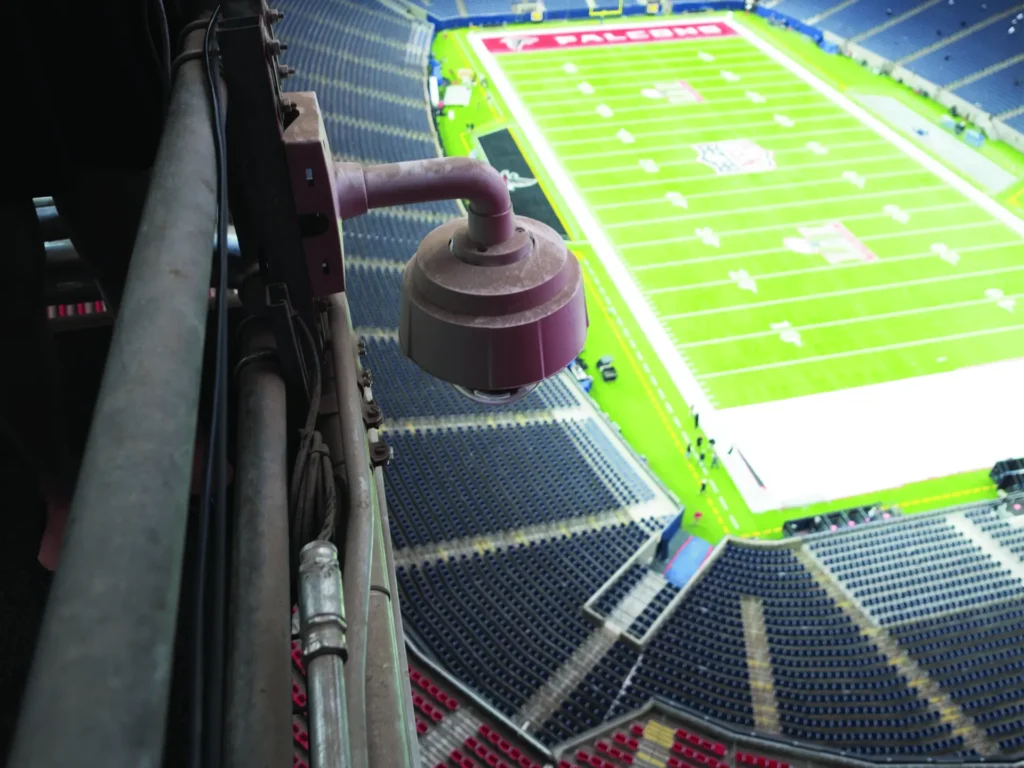
Long-range CCTV is designed for locations where the area you need to see may be hundreds of metres from the nearest building, network connection or recording equipment. It can extend video surveillance across farms, industrial yards, construction sites, parking areas, campuses, large residential properties and other multi-building or wide-area sites without treating every remote location as a separate system.
A long-range CCTV installation has to solve two different problems at the same time: the camera must produce enough usable detail at the target, and the network must carry that video reliably back to the recording or monitoring point. For that reason, TNSG designs the camera, lens, mounting position and network path as one system rather than selecting equipment from a maximum-distance specification alone.
TNSG designs the monitoring layer around those decisions, including operator coverage, AI analytics, communication reliability and the response options available at the property.
Measure the actual distance between each camera position and the area where useful video detail has to be captured.
Define whether you need detection, observation, recognition or identification before selecting the camera resolution, sensor and lens.
Match focal length and optical zoom to target size so distant subjects remain useful without depending on digital enlargement.
Choose fibre, wired or point-to-point wireless backhaul according to distance, line of sight, capacity and available site infrastructure.
Plan for available light, infrared reach, glare and darkness because daytime performance does not predict nighttime results accurately.
Account for pole height, wind, vibration, weather exposure and service access so distant images remain stable and maintainable.
Remote cameras do not need to operate as an isolated surveillance system. Once their video reaches the main security network, it can become part of the same recording, monitoring and event-management environment used elsewhere on the property.
Long-distance surveillance introduces design issues that are easy to miss when comparing camera specifications alone. These questions explain several of the technical decisions that affect image quality, network reliability and the usefulness of recorded video after installation.
No. A PTZ camera provides optical zoom and the ability to move between different areas, which is valuable when an operator needs to investigate activity across a large site. The trade-off is that a PTZ camera can only be pointed at one area at a time, so activity elsewhere may not be captured at the required detail.
For important fixed targets such as a gate, driveway or loading entrance, a dedicated fixed camera may provide more consistent evidence. Some systems therefore combine fixed long-range cameras for continuous coverage with PTZ cameras for investigation and tracking.
It can, but simply installing a high-resolution camera with a powerful zoom does not make it a licence plate camera. Plate capture depends on the number of pixels across the plate, camera angle, vehicle speed, shutter settings, exposure, lighting and the distance at which the plate must be captured.
Where licence plates are an important operational requirement, the view should be designed specifically around that task rather than relying on a general overview camera. A separate LPR or plate-capture camera may be appropriate while another camera maintains wider situational coverage.
Thermal cameras are useful when the primary objective is detecting people, vehicles or other heat-producing objects across dark or difficult perimeter environments. Because thermal imaging is based on emitted heat rather than visible light, it can continue detecting activity in complete darkness and can perform better than conventional video in some conditions involving light fog or smoke.
Thermal video is not a substitute for a detailed visible image when colour, clothing, facial detail or other identifying information is required. For higher-risk perimeters, thermal detection can therefore be paired with a visible-light camera or PTZ for closer verification.
Weather can affect both sides of the system. Heavy precipitation, fog, dirty lenses and poor illumination can reduce visible image detail, while wind or vibration becomes much more noticeable when a camera is viewing a narrow scene at significant distance.
Weather can also affect long-distance wireless links, particularly when the link already has limited signal margin. Stable mounting, appropriate environmental ratings, link engineering and access for maintenance are therefore important parts of an outdoor Ontario installation rather than secondary equipment considerations.
In most long-distance point-to-point installations, clear line of sight is highly important. The radio path also requires sufficient clearance around the direct visual path, known as the Fresnel zone; trees, buildings, terrain or new construction inside this area can weaken an otherwise visible connection.
This is why a long-range wireless link should be surveyed before permanent mounting. Where a direct path is not practical, the design may require different mounting elevations, an intermediate relay point, fibre or another form of backhaul.
Internet access and local video recording are not necessarily the same thing. A properly designed local system can continue passing video from the cameras to an on-site recorder even when the external ISP connection is unavailable, provided the local network and camera backhaul remain operational.
Remote viewing, cloud-dependent functions or off-site monitoring may be interrupted until connectivity returns. Depending on the equipment, edge storage at the camera can also provide an additional recording layer, but its behaviour and recovery process should be verified during system design.
Long-range video does not automatically consume more bandwidth simply because the camera is far away. Capacity is driven mainly by resolution, frame rate, compression format, scene activity, camera count, recording settings and the required retention period.
The network still needs enough sustained capacity and headroom to carry every required stream without affecting live viewing or recording. Modern video compression can reduce bandwidth and storage requirements substantially, but compression settings should not be increased so aggressively that important distant detail is lost.
Yes. Where a commercial, institutional or government procurement policy requires NDAA-compliant equipment, compatible cameras and network components can be specified during the design stage.
Compliance should be checked at the manufacturer and model level rather than assumed from a general product category. This is particularly important in a long-range system because cameras, wireless bridges, recorders and other network components may come from different product families.
Security technologies are often more effective when they work together. Depending on the property and the risks involved, this solution may be combined with other systems.
A single technology may address one part of a security challenge, but effective protection often depends on how different systems, property conditions and operational needs work together. Explore our comprehensive security services for a broader approach to planning, improving or evaluating your property.
Tell us about the property, your current concerns and what you would like to improve. Our team will review the details and help determine the most appropriate next step, whether you need a new system, an upgrade or a professional assessment.
For technical support with an existing TNSG system, please visit our Help Center.