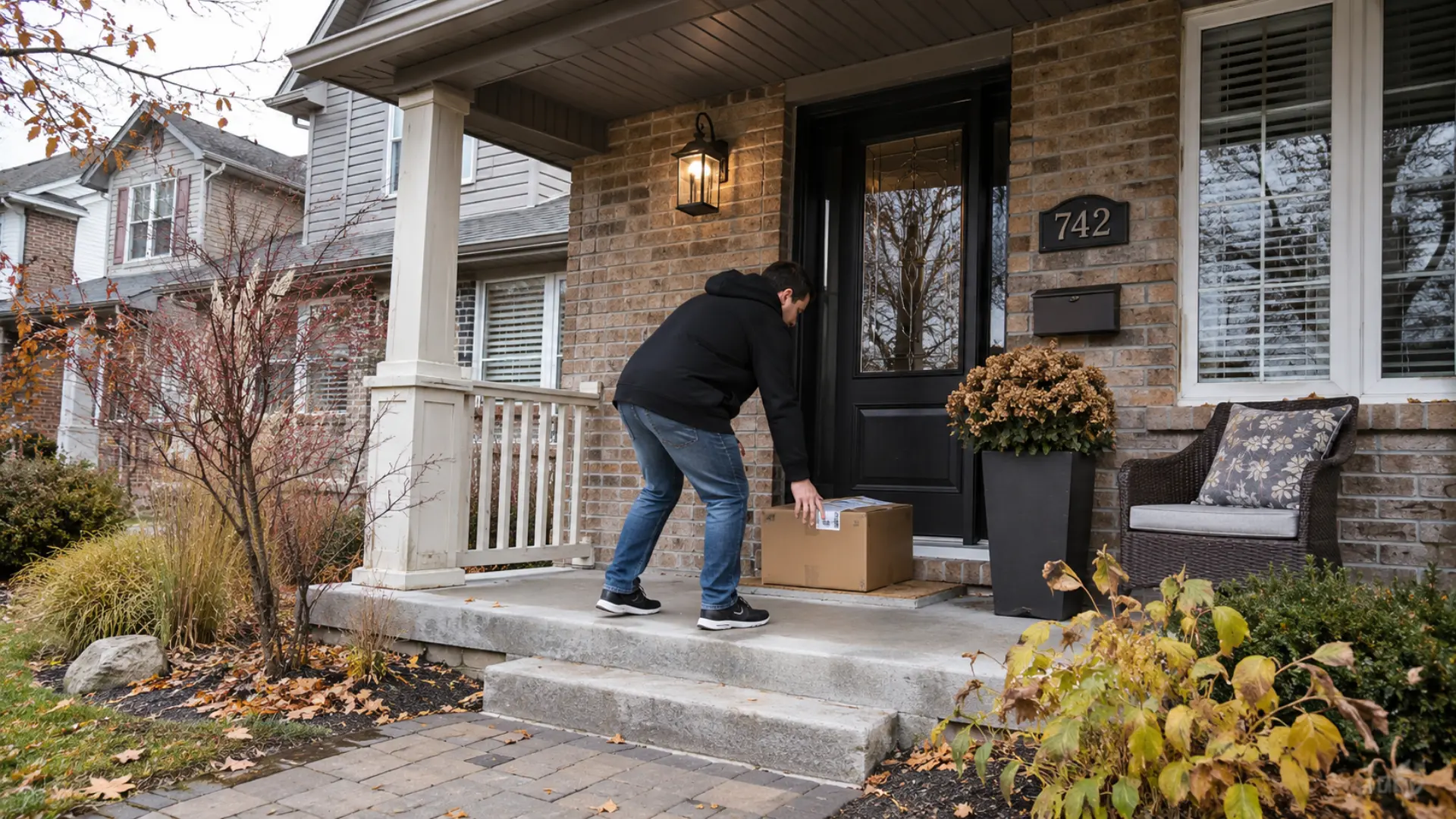
Your order arrives while you are at work, and the retailer sends a delivery notification showing a box beside your front door. When you return home, the package is gone. You now have to contact the seller, check the tracking history and work out whether the delivery was misplaced or stolen.
For many Toronto homeowners, deliveries are left on steps that anyone can approach from the street. A package may remain there for hours, even though taking it would require only a brief visit. This is the opportunity that porch pirates exploit, and it is worth asking how often your own deliveries are left exposed.
The RCMP recommends combining practical delivery arrangements with measures such as lighting and visible security cameras. The goal is to reduce opportunities for theft, improve your awareness of activity around the entrance and make it easier to establish what happened if something disappears. No single device can do all three jobs.
Why Packages Disappear From Front Doors
An unattended parcel tells a passerby that something has been delivered and not yet collected. Its packaging often offers little indication of the value inside, so even ordinary purchases may attract attention. Homes with open front steps, short approaches from the sidewalk or entrances screened from the occupants’ view can be particularly difficult to supervise during the workday.
The relevant risk is not simply whether your neighbourhood has experienced theft. Consider how visible the delivery area is, whether couriers leave packages in the same place and how quickly someone in your household can bring them indoors. A camera may be useful, but its position and recording settings matter far more than the presence of a lens over the door.
Arrange Deliveries Before They Reach Your Door
Use a secure pickup option for important orders
When you cannot receive an expensive or difficult-to-replace purchase, a staffed pickup location or parcel locker may be preferable to an unattended doorstep. Some retailers and couriers also let you redirect a shipment or hold it for collection. Check the available options before ordering because they vary by retailer, carrier and shipping service.
Canada Post offers free FlexDelivery to participating post offices when the retailer can ship to the special address provided through the service. It applies to Canada Post deliveries, not parcels shipped through other carriers. For shipments that support it, a signature requirement or hold-for-pickup arrangement can also reduce the likelihood of an item being left outside.
Give practical instructions to the courier
If home delivery is necessary, choose a location that is sheltered, accessible and less visible from the sidewalk. A side entrance or recessed porch may be suitable if the driver can reach it without entering a locked area or approaching an unattended animal. An instruction that is difficult or unsafe to follow is unlikely to improve delivery security.
Canada Post lets recipients set delivery preferences for eligible parcels through its tracking tools. Its normal delivery procedures take priority, however, and the preferred location may be used only if delivery through those procedures is not reasonably possible. Signature requirements and other restrictions can also make an item ineligible, while private couriers follow their own rules.
Make collection part of the household routine
Enable tracking alerts, but distinguish an estimated arrival window from a completed delivery. If you will be away, arrange in advance for a trusted neighbour or family member to collect the parcel. Give that person the delivery details they need, rather than assuming someone will notice a box outside.
Where several people order online, agree on who checks delivery notifications and brings items inside. This small change can prevent a package from sitting on the steps after everyone assumes that someone else has collected it. It also helps you recognize a genuinely missing delivery sooner.
Improve the Physical Delivery Area
A parcel does not need to be displayed in the middle of the front step. Look at your entrance from the sidewalk and identify whether an accessible, sheltered drop-off point could keep the package out of casual view. The location should remain obvious to delivery drivers without obstructing steps, doors or walkways.
For households receiving frequent deliveries, a purpose-built parcel box may provide a more secure option. A useful design lets a courier deposit an item while limiting access to its contents afterwards, although the box must be large enough for typical orders and simple enough for drivers to use. An ordinary unlocked storage bench may conceal a parcel but will not necessarily keep someone from taking it.
Lighting supports both visibility and surveillance. A porch fixture or motion-activated light can make an approach more noticeable and help a camera record clearer footage during Ontario’s darker months. Check the result after sunset because harsh glare and deep shadows can make faces, clothing and package movements harder to see.
Physical improvements and surveillance serve different purposes. A secured container makes the item harder to remove, while lighting and cameras increase the chance that activity will be noticed or documented. Used together, they address more than one weakness in an exposed delivery area.
What Doorbell Cameras and CCTV Provide
A video doorbell can notify you when someone approaches the entrance and, on supported models, allow two-way communication through an app. You may be able to speak to a courier or check whether a delivery has arrived while you are away. However, a doorbell mounted beside the frame may miss a package placed directly below it, and an alert can arrive after someone has already left.
Coverage is more important than camera count
A professionally planned CCTV system can cover the delivery spot as well as the route a person takes to reach it. Depending on the home, this could mean a camera with a clear view of the steps, another overlooking the driveway or a different lens that captures useful detail without excessive distance. The aim is not to record the largest possible area but to capture activity that you can understand and review.
With an IP camera system, video travels over a network to storage such as a network video recorder, or NVR. Some installations support continuous recording, while others record around detected events, and retention depends on available storage and system settings. If a camera begins recording too late or footage is overwritten before you discover a loss, even a high-resolution image may provide little help.
A professional CCTV installation begins with planning camera positions, lighting conditions, recording needs and secure remote access. A practical design considers where couriers stand, where packages are left and what the image looks like after dark. Existing equipment may also benefit from changed settings or a better viewing angle rather than wholesale replacement.
Alerts and active deterrence need proper configuration
Some modern cameras use video analytics to distinguish people and vehicles from ordinary background motion. This can make notifications more relevant, especially where passing traffic or moving branches would otherwise create repeated alerts. Analytics cannot reliably determine whether a person is stealing a parcel, so detection zones and event rules need testing against normal household activity.
Compatible equipment may also support warning lights, audible alerts or two-way audio. Those features can attract attention to a defined event or allow an authorized person to speak through the system. Their availability and effectiveness depend on the selected camera, other connected devices and the way they are configured.
Professional installation can address privacy as well
Homeowners do not have to choose between useful coverage and responsible camera placement. The City of Toronto provides best-practice guidance for residential security cameras, including consideration of neighbouring properties, appropriate recording areas and protection of stored footage. These are guidelines rather than a municipal ban on residential cameras.
An experienced installer can plan views around the areas you actually need to protect, adjust camera angles and apply privacy masking where equipment supports it. Detection zones can be configured separately so that routine activity away from the entrance does not create unnecessary alerts. Access permissions, secure passwords and appropriate retention settings also help protect recordings, allowing the system to fit your property and security goals without collecting unnecessary footage.
When Live Video Monitoring Adds Value
Recording an incident helps you understand it afterwards, but it does not mean anyone is watching when it happens. With a standard camera app, you must see the notification, open the video and decide whether to respond. That may be difficult while you are driving, working or travelling, especially if the system sends frequent alerts.
Live Video Monitoring adds a professional monitoring process to compatible cameras. Depending on the agreed service plan, trained operators may review events flagged by video analytics or watch selected feeds during defined periods. They can assess the available images and follow predetermined procedures, which may include notifying you, using compatible audio deterrence equipment or escalating an incident when appropriate.
For a home with several exterior cameras, this can be valuable beyond deliveries alone. The same planned coverage may address activity around entrances, vehicles, side paths and other accessible areas. Monitoring schedules, the areas being watched and the permitted response should reflect how the household uses the property, including routine courier visits.
A delivery does not become a security incident simply because someone carries a box past a camera. Professional monitoring still depends on reliable connectivity, adequate video quality and sensible event rules, and no operator or analytics platform can guarantee that every theft will be detected or interrupted. Its advantage is the opportunity for timely assessment and a defined response when suspicious activity meets the agreed criteria, rather than relying entirely on recordings reviewed later.
What to Do When a Package Goes Missing
A tracking page marked “Delivered” does not prove that your parcel was stolen. It may have been left in an unexpected safe-drop location, accepted by another household member or taken to the wrong address. Establishing what happened before reporting a theft can make the follow-up faster and more accurate.
- Confirm the delivery details. Review the tracking information, photograph and any available signature record. Check around the front and side entrances, then ask everyone at home whether they collected the parcel. If the delivery photograph shows a different property, save it as possible evidence of misdelivery.
- Contact the seller and delivery company. Give them the order and tracking numbers, describe the missing package and request an investigation or guidance under their procedures. Refunds, replacement shipments and compensation depend on the circumstances and applicable terms. For Canada Post shipments, a recipient can request an investigation, but only the sender can submit a compensation claim to Canada Post.
- Preserve relevant footage. Save the original video covering the delivery and the period before and after the suspected disappearance, including the correct date and time where possible. If a nearby homeowner may have a useful view, ask whether they would be willing to preserve relevant footage. Avoid editing the only copy or publicly accusing anyone before the facts have been established.
- Report a suspected theft. The Toronto Police Service online reporting system accepts eligible non-emergency theft reports for incidents within Toronto. You can also use the non-emergency number, 416-808-2222. Call 911 if a crime is in progress or an emergency requires an immediate police response.
- Keep a record of the loss. Retain your receipt, delivery notifications, messages with the seller or carrier and the police report reference number. If the matter remains unresolved, review the payment provider’s dispute process and deadlines, describing the circumstances accurately. For a high-value loss, check insurance coverage and the deductible before submitting a claim.
Video may show someone taking a package without proving that you know the person’s identity. Do not confront a suspected thief or post unverified accusations on neighbourhood groups. Provide relevant evidence to the police and allow investigators to assess it.
Make Your Entrance Part of a Security Plan
The most effective approach combines secure delivery arrangements with a physical space that does not invite easy theft. Pickup options and prompt collection reduce the time a parcel is exposed, while delivery boxes and thoughtful lighting make the entrance more suitable for unattended deliveries. Cameras can add visibility, retrievable evidence and, where supported, notifications or active deterrence.
If you regularly receive deliveries while away, your front entrance deserves the same deliberate planning as the rest of your property. True North Security Group’s residential security systems can be designed around entrance coverage, reliable recording, remote access and the option of professional video monitoring where appropriate. Contact TNSG to discuss how your current setup could be improved and which combination of measures fits your home, routine and security priorities.